
The best drug treatment center in NJ is one that is licensed, offers the level of care your situation requires, builds an individual plan for each patient and plans for life after discharge. Which program fits depends on the substance, the severity of use, any co-occurring mental health conditions and how much structure the person needs to stay safe.
Most people never reach treatment at all. SAMHSA’s 2024 NSDUH state-specific tables indicate that most New Jersey residents classified as needing substance-use treatment did not receive it. Choosing well, and acting early, matters. This guide explains the levels of care, the quality markers to verify, four residential programs in the state and the questions to ask before committing.
What Does a Drug Treatment Center in NJ Actually Provide?
A drug treatment center provides medically supervised care and structured therapy to help a person stop using substances and build the skills to stay sober. The scope varies, so it helps to separate the main services:
- Detoxification: Medically managed withdrawal, often the first step for alcohol, opioids and benzodiazepines, where stopping abruptly can be dangerous.
- Residential or inpatient treatment: The patient lives at the facility around the clock and follows a highly structured daily schedule.
- Outpatient care: Scheduled sessions while the person lives at home. Intensive outpatient programs sit at the higher-intensity end.
- Medication-assisted treatment: FDA-approved medications for opioid or alcohol use disorder combined with counseling.
- Aftercare: Relapse prevention planning, ongoing therapy and recovery support after the main program ends.
Quality programs combine several of these rather than relying on a single approach. A person detoxing from alcohol, for example, usually needs a handoff into therapy within days, not weeks. That handoff is something to ask about directly.
Levels of Care: Matching Treatment to Need
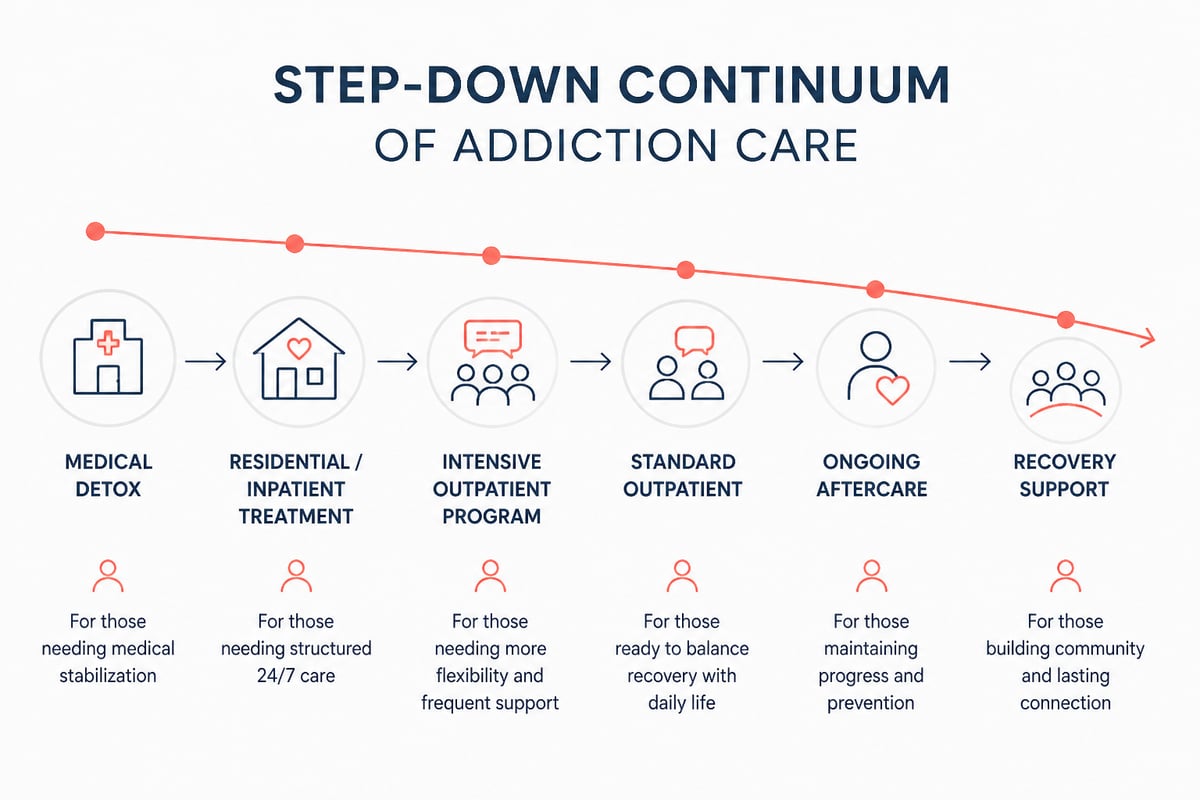
The right level of care is the least restrictive setting that can still keep the person safe and make progress realistic. Clinicians commonly use the American Society of Addiction Medicine criteria to make this match, weighing withdrawal risk, medical and mental health conditions, readiness to change, relapse history and the stability of the home environment.
| Level | Where the patient lives | Typical fit |
|---|---|---|
| Detox | Facility or hospital unit | Withdrawal that needs medical monitoring |
| Residential/inpatient | Facility, 24/7 | Severe use, repeated relapse, unsafe or unsupportive home |
| Intensive outpatient | Home | Stable housing, needs several hours of therapy weekly |
| Standard outpatient | Home | Milder use or step-down after higher care |
Residential care is usually recommended when earlier attempts at outpatient treatment have not held, when withdrawal carries medical risk or when the home environment makes abstinence unrealistic. Many people move through the levels in sequence: detox, residential, intensive outpatient, then standard outpatient.
Quality Markers to Verify Before You Choose
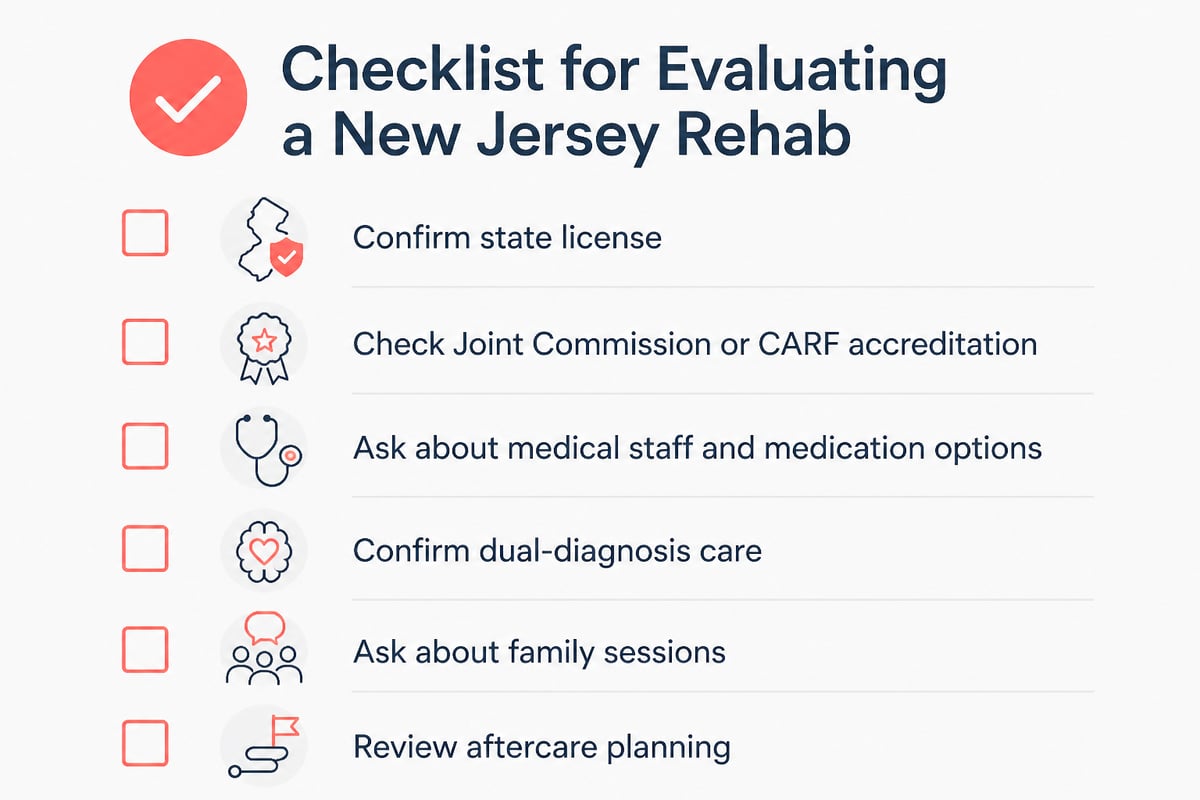
Verify five things before committing, because marketing language is easy to produce and credentials are not.
- State licensure. New Jersey facilities should be licensed to provide substance use disorder treatment. The state's Division of Mental Health and Addiction Services reports page links to its substance-use overview dashboard and other official data.
- Accreditation. Joint Commission or CARF accreditation indicates an outside body has reviewed clinical and safety practices.
- Clinical staffing. Ask who prescribes, who provides therapy and what credentials they hold. Round-the-clock medical coverage matters in residential settings.
- Evidence-based methods. Look for cognitive behavioral therapy, motivational interviewing, contingency management and appropriate use of medication rather than vague promises.
- Dual-diagnosis capability. Depression, anxiety and trauma frequently accompany addiction. A program that treats only one condition leaves the other to undermine recovery.
Also ask about outcomes tracking and discharge planning. A center unwilling to explain how it measures progress or what happens after day 30 is telling you something.
Four Residential Programs in New Jersey
Four residential programs in the state are worth examining. The details below come from public listings, and you should confirm services, availability, insurance acceptance and costs directly with each facility.
1. Blake Recovery Center at Carrier Clinic
Blake Recovery Center is a residential addiction treatment center at Carrier Clinic. It is best suited to people who want residential care and expect medical or psychiatric needs to overlap with treatment.
2. AtlantiCare Inpatient Residential Treatment
AtlantiCare offers inpatient residential addiction treatment. It fits people in southern New Jersey who want inpatient care connected to a regional hospital network and prefer to stay close to home.
3. Recovery Centers of America at Lighthouse
Recovery Centers of America at Lighthouse is a residential addiction treatment facility in southern New Jersey. It is a reasonable option for people seeking residential treatment in southern New Jersey who want to compare more than one program in the same area.
4. The Recovery Village Cherry Hill at Cooper (Cooper University Health Care)
This residential addiction treatment program is located in Cherry Hill. It suits people in the Cherry Hill and greater Philadelphia-area corridor who want residential care tied to an academic health system.
5. Individual Care Center: Inpatient Substance Abuse Treatment
Individual Care Center is the publisher of this article, so weigh this entry with that in mind. Its Inpatient Substance Abuse Treatment service is residential care with 24-hour medical supervision, individual and group therapy, medication management and aftercare planning. The approach is built around each patient, with a tailored recovery plan for every person, and family members take an active part in treatment. Care is holistic, pairing counseling and medication with therapies such as acupuncture and yoga.
The service is also discreet and private, and treatment is offered regardless of gender, race, orientation, age, socioeconomic status or background. An honest limitation: location, insurance and bed availability should be confirmed by contacting the center directly.
6. Individual Care Center: Intensive Outpatient Program
For people who do not need to live at a facility, the Intensive Outpatient Program offers structured rehabilitation that meets 3 hours a day, 3 days a week. It includes group, family and individual therapy along with relapse prevention education. It works best as a step-down after residential care or for someone with a stable home and a firm commitment to attend. It is a weaker choice for anyone facing serious withdrawal risk or an unsafe living situation.
Why Individualized Plans and Family Involvement Matter
A treatment plan written for one person outperforms a generic curriculum because addiction rarely looks the same twice. Two patients using the same substance may differ in trauma history, medication needs, work obligations and family dynamics. A program that assesses these factors first and then assigns therapies is doing the clinical work correctly.
Family involvement deserves the same scrutiny. Addiction affects the whole household, and relatives often hold information that clinicians need. Good programs schedule family sessions, teach loved ones how to support recovery without enabling use and prepare everyone for the transition home.
Privacy is a practical concern too. Many adults delay treatment because they fear disruption at work or at home. Ask any program how it protects confidentiality and whether it can coordinate around professional obligations. For more on how structured programs are organized, see Individual Care Center's overview of treatment programs.
Questions to Ask Before Admission
Asking pointed questions before admission protects your time, money and safety. Bring this list to every call:
- Is the facility licensed in New Jersey, and which accreditations does it hold?
- Who provides medical care, and is a clinician on site 24 hours a day?
- Is medication-assisted treatment offered when clinically appropriate?
- How is each patient's plan created, and how often is it reviewed?
- How are family members involved, and how often?
- What happens at discharge, and what aftercare is arranged?
- How are privacy and confidentiality handled?
- What will insurance cover, and what costs will fall to the patient?
Cost deserves a direct conversation. Prices vary widely by program length and setting, and many facilities verify insurance benefits before admission. Request a written breakdown rather than relying on a verbal estimate.

Understanding the Scale of the Need in New Jersey
New Jersey publishes substance-use treatment data that can help put an individual decision in context. SAMHSA's 2024 Treatment Episode Data Set page presents New Jersey admissions by primary substance and demographic characteristics, while its 2024 discharge data page summarizes discharges by substance and demographics. These figures show that people seek treatment for a wide range of substances and that no single profile defines who enters care.
That variety is a reason to avoid one-size-fits-all programs. It is also a reason for families to stop waiting for a perfect moment. The gap between those who need treatment and those who receive it is large, and most of that gap closes only when someone makes the first call.
Red Flags When Evaluating a Program
Certain warning signs should prompt you to keep looking:
- Guarantees of a cure or promises of specific success rates
- Pressure to commit immediately or high-pressure admissions calls
- No clear answer about licensure or accreditation
- No medical staff presence for a program that offers detox
- Refusal to discuss costs in writing
- A rigid schedule applied to every patient with no assessment
- No aftercare or discharge plan
Each of these has a practical test. If a representative claims a license or accreditation, check it yourself through the state's Division of Mental Health and Addiction Services or the accrediting body rather than accepting a verbal assurance. If a program advertises detox, ask which clinician evaluates withdrawal and how often vital signs are monitored, since alcohol and benzodiazepine withdrawal can become dangerous quickly. A vague answer to either question is reason enough to move on. Be cautious, too, when an admissions line quotes a price before asking a single clinical question, because that sequence suggests billing drives placement rather than need.
Addiction is a chronic condition with a real risk of relapse, so honest programs talk about managing it, not eliminating it forever. A center that speaks plainly about limits is generally more trustworthy than one that does not.
How to Take the First Step
Starting is simpler than it appears:
- Gather basic information: substances used, how long, prior treatment attempts, current medications and insurance details. Write it down before the first call, including any past withdrawal symptoms such as seizures or severe tremors, because clinicians use that history to judge whether detox needs medical monitoring. Keep your insurance card and member ID beside you so the facility can begin verifying benefits during the same conversation.
- Call two or three programs and ask the questions above. Comparing answers side by side makes differences in staffing, licensure and discharge planning easy to see. Take notes on who you spoke with and what was promised, and ask for anything that affects cost in writing.
- Request an assessment to confirm the right level of care. A thorough assessment covers withdrawal risk, mental health, medical conditions and home stability, and it may recommend a different setting than the one you expected.
- Involve a trusted family member in the decision and in treatment planning. Having a second person on calls helps with recall and accountability.
- Set an admission date and prepare for the transition, including time away from work. Arrange coverage for childcare, pets, bills and any medications that need to be handled before you arrive.
Choosing a drug treatment center NJ families can rely on takes a few focused conversations, and those conversations are worth having this week.
Start today by writing down the substances involved, how long use has continued and any prior treatment, then call a program and ask for an assessment. If residential care looks like the right fit, review the Inpatient Substance Abuse Treatment service, which offers 24-hour medical supervision, tailored recovery plans and active family involvement. When you are ready to talk with someone about options, reach out to Individual Care Center and call 866-693-1454 to discuss which level of care suits your situation.