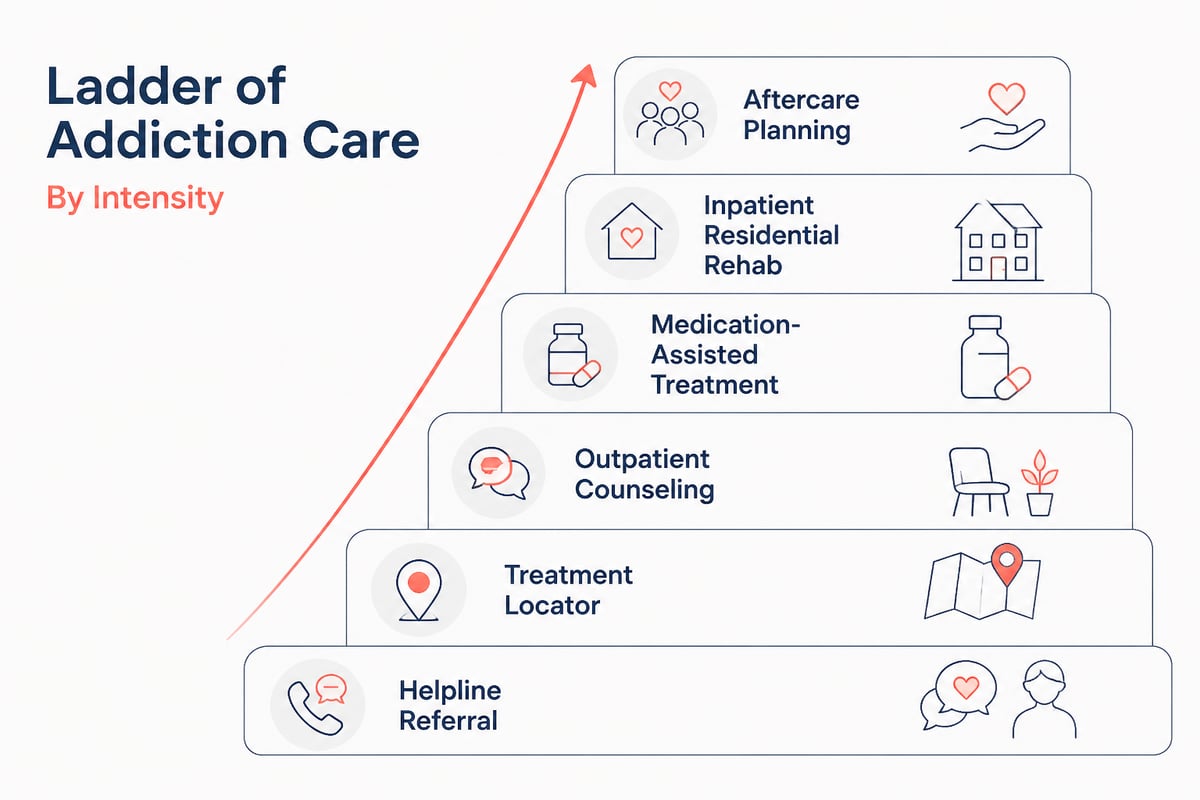
Treatment programs for addiction are structured plans that combine medical care, therapy and support to help a person stop using drugs or alcohol and stay in recovery. They range from a single phone referral to 24-hour residential care, and the right fit depends on the substance involved, the severity of use, any co-occurring mental health conditions and the level of support available at home.
This list covers the main options adults and families weigh, starting with free national services that point toward care and moving to clinical programs. Each entry names what the option is, its key features, approximate cost where known, the situation it suits and a one-line verdict. Prices are approximate as of November 2026.
1. SAMHSA's National Helpline
SAMHSA's National Helpline is a free referral service that connects people with local treatment facilities, support groups and community organizations. According to the SAMHSA National Helpline, it is confidential and open 24 hours a day, 365 days a year, in English and Spanish.
- Contact: 1-800-662-HELP (4357); TTY 1-800-487-4889
- Cost: $0 USD
- Format: Trained information specialists answer calls and route callers to state services, intake centers and local assistance
The helpline does not provide counseling. Its job is referral and information, which makes it a starting point rather than a treatment in itself.
Best for: Adults and families who need confidential help locating treatment at any hour, including nights and weekends.
Verdict: The simplest first call when you do not yet know which type of care you need.
2. HELP4U Text Messaging Service
HELP4U is a text-based version of the same referral service for people who would rather not talk on the phone. Text a 5-digit ZIP code to 435748 (HELP4U) to receive information on nearby treatment, as described on the SAMHSA National Helpline page.
- Cost: $0 USD; message and data rates may apply
- Commands: Reply STOP to cancel or HELP to reach an information specialist
- Language: Currently available in English
- Message frequency: Varies
Best for: People who prefer texting to calling, or who need to ask for help discreetly while others are nearby.
Verdict: A low-pressure way to find local options, limited to English for now.
3. Referral Services for People Without Insurance
Cost is a common barrier, and SAMHSA's referral service is designed to address it. The helpline referral is free, and callers without insurance or who are underinsured may be directed to state offices, state-funded programs, or facilities with sliding-fee scales or that accept Medicare or Medicaid, per the SAMHSA National Helpline.
- Cost: $0 USD for the referral itself
- Referral types: State-funded programs, sliding-fee facilities, Medicare- or Medicaid-accepting programs
- Related resource: SAMHSA's treatment-support page explains treatment types, making appointments, preparing for treatment and options for paying for care
Best for: Adults concerned about the price of treatment who need to know what financial options exist before committing.
Verdict: Worth asking about early, since funding questions shape which programs are realistic.
4. Treatment Locator Directories
Directories let you search for facilities yourself instead of waiting on a call. SAMHSA maintains several, and its list of treatment locators includes the National Helpline, FindTreatment.gov and the Opioid Treatment Program Directory.
- Cost: Free to search
- Coverage: Facilities by location and, in some directories, by type of care
- Use: Build a shortlist, then verify services, availability and payment directly with each program
Best for: Families comparing several facilities side by side, or anyone who wants to research on their own schedule.
Verdict: Useful for building a shortlist, though it still requires direct calls to confirm fit.
5. Outpatient Treatment Programs
Outpatient treatment programs let patients live at home and attend scheduled counseling, group sessions and medical check-ins. Intensity varies from a few hours a week to several hours a day.
- Typical components: Individual therapy, group therapy, relapse-prevention education, drug testing
- Setting: Clinic or community-based; no overnight stay
- Cost: Varies by provider and insurance
Outpatient care depends on a reasonably stable home environment and the ability to avoid triggers between sessions. It is often used after residential care as a step down, and as a primary option for mild to moderate use disorders.
Best for: Adults with stable housing, strong support at home and a need to keep working or caring for family during treatment.
Verdict: A flexible choice when the home setting supports recovery, and a common next step after inpatient care.
6. Medication-Assisted Treatment (MAT) at Individual Care Center
Medication-Assisted Treatment combines FDA-approved medication with counseling and behavioral therapy. Individual Care Center’s MAT service addresses opioid, alcohol and tobacco dependence.
- Approach: Medication paired with counseling and behavioral therapy, rather than medication alone
- Substances covered: Opioids, alcohol and tobacco
- Plan: Individual Care Center builds a tailored recovery plan for each patient
- Cost: Contact Individual Care Center for details
Medication can reduce cravings and withdrawal symptoms, which gives therapy a steadier foundation. Individual Care Center describes its care as open to people regardless of background.
Best for: Adults with opioid, alcohol or tobacco dependence who want medication supported by counseling and behavioral therapy.
Verdict: A strong evidence-based option when cravings and withdrawal are the main obstacles to staying sober.
7. Inpatient Substance Abuse Treatment at Individual Care Center
Inpatient rehab means living at a treatment facility around the clock while receiving structured, supervised care. Individual Care Center’s inpatient substance abuse treatment offers residential addiction care with 24-hour medical supervision, individual and group therapy, medication management and aftercare planning.
- Supervision: 24-hour medical oversight
- Care model: Holistic, combining counseling, medication and therapies such as acupuncture and yoga
- Privacy: Residential care that keeps patients away from everyday triggers
- Family role: Family members are actively involved in the treatment process
- Cost: Contact Individual Care Center for details
The structure removes day-to-day triggers and gives patients a consistent routine. Individual Care Center's inpatient service is designed to give patients a consistent, structured routine.
Best for: Adults with severe or long-standing addiction, a history of relapse, or unsafe withdrawal risk who need constant support and a structured environment.
Verdict: The most intensive option, and the one to consider first when outpatient care has not held.
8. Co-Occurring Disorder Treatment
Co-occurring disorder treatment addresses addiction and a mental health condition together. SAMHSA's co-occurring disorders guidance identifies three care models: coordinated, co-located and fully integrated treatment.
- Coordinated: Separate providers who communicate and align plans
- Co-located: Both services offered at one site, with separate teams
- Fully integrated: One team treats both conditions as a single plan
- Cost: Varies by provider and insurance
Treating only one condition often leaves the other to undermine progress. Anxiety, depression and trauma commonly drive substance use, so a plan that handles both reduces the chance of relapse.
Best for: Adults who also live with depression, anxiety, PTSD or another mental health diagnosis alongside substance use.
Verdict: Essential when mental health symptoms and substance use feed each other.
9. Aftercare and Continuing Support Planning
Aftercare is the plan that carries recovery beyond the formal program, and it is one of the strongest predictors of long-term stability. It typically combines ongoing therapy, peer support groups, medication follow-up and a relapse-prevention plan.
- Common elements: Outpatient counseling, mutual-support meetings, sober living referrals, check-ins with a clinician
- Timing: Planned before discharge, not after
- Link to inpatient care: Aftercare planning is part of Individual Care Center's inpatient service
Support groups also appear in helpline referrals, since SAMHSA's service connects callers with community-based organizations as well as facilities.
Best for: Anyone finishing a residential or intensive program who needs a clear structure for the first months at home.
Verdict: Treat it as part of the program, not an optional extra.
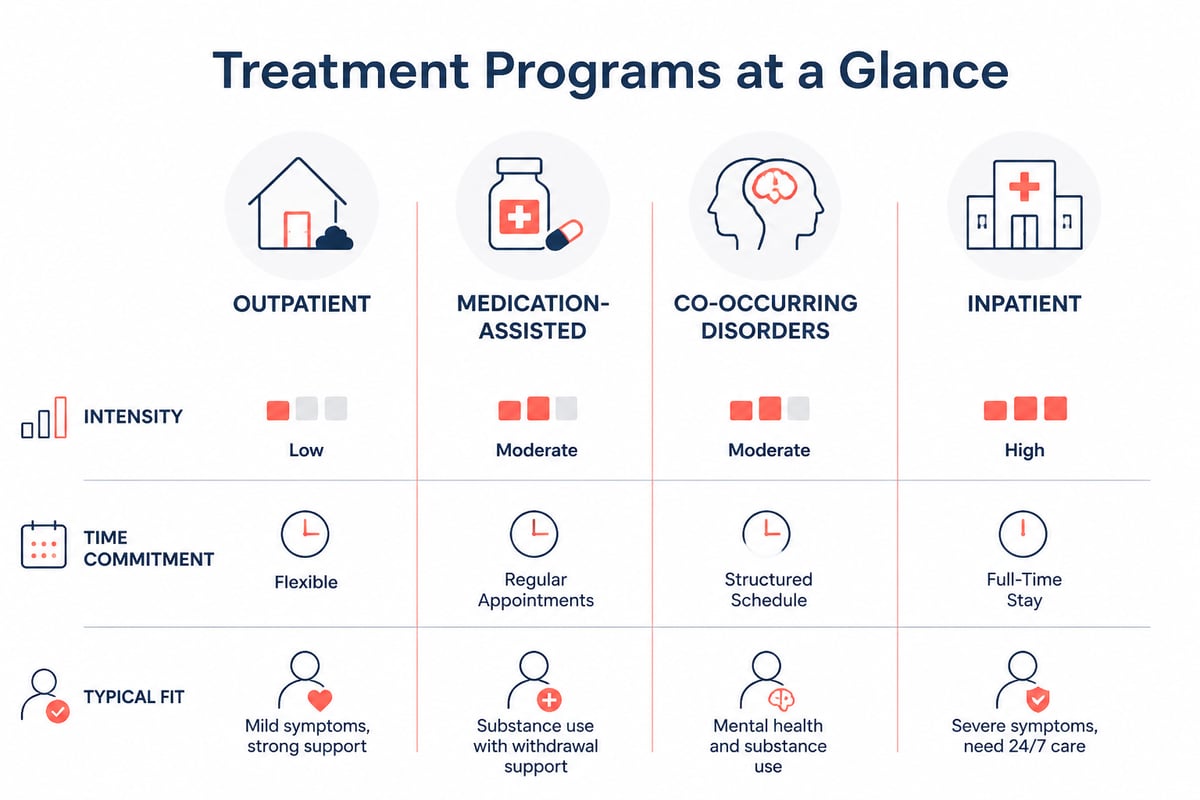
Treatment Programs Compared
The table below summarizes the options by format and fit. Individual Care Center's two services are listed alongside the national resources and general program types.
| Option | Format | Cost (approx., Nov 2026) | Best suited to |
|---|---|---|---|
| SAMHSA National Helpline | Phone referral, 24/7 | $0 | First contact and referrals |
| HELP4U text service | Text referral | $0 (rates may apply) | Discreet, text-based search |
| Referral for uninsured callers | Phone referral | $0 | Cost concerns |
| Treatment locator directories | Online search | $0 | Building a facility shortlist |
| Outpatient programs | Scheduled sessions | Varies | Stable home, mild to moderate use |
| Medication-Assisted Treatment | Medication plus therapy | Contact provider | Opioid, alcohol or tobacco dependence |
| Inpatient treatment | 24-hour residential | Contact provider | Severe use, relapse history |
| Co-occurring disorder care | Coordinated or integrated | Varies | Addiction plus mental health diagnosis |
| Aftercare planning | Ongoing support | Varies | Transition after intensive care |
The first four rows are entry points, not treatment. A caller might phone the helpline at 1-800-662-HELP, receive two or three local referrals, and then use a locator directory to compare those facilities before calling each one. The remaining rows are clinical care, and they often combine. A patient might begin with inpatient treatment, continue with outpatient sessions and medication, and rely on aftercare planning once home. Co-occurring care is less a separate stage than a way of delivering any of these, so it applies whenever a mental health diagnosis is present. Where the cost column says "Varies" or "Contact provider," confirm pricing and insurance acceptance directly with each program before committing.
How to Choose Among Treatment Programs
Match the intensity of care to the severity of the problem, and expect to adjust as recovery progresses. A few questions help narrow the field:
- Is withdrawal medically risky? Alcohol and certain drugs can cause dangerous withdrawal, which points toward medical supervision.
- Is home a safe place to recover? If triggers, access to substances or conflict are constant, residential care removes them.
- Is there a mental health condition? If so, look for programs that treat both together.
- What have past attempts shown? Repeated relapse after lighter care suggests stepping up the level.
- What can be paid for? Ask about insurance, sliding-fee options and state-funded programs early.
Individual Care Center's holistic model, which combines counseling, medication, acupuncture and yoga, is one example of how a program can address more than the substance itself. Its tailored recovery plans and family involvement reflect how many adults find lasting results when treatment is built around the individual.

FAQ
What is the most successful recovery program?
No single program works best for everyone. Outcomes tend to be strongest when the level of care matches the person's needs and when treatment combines therapy, medication where appropriate, and ongoing support after discharge. A person with opioid dependence may do best with medication-assisted treatment paired with counseling, while someone with a long relapse history may need residential care first. The practical step is to ask a clinician which level of care fits your situation, then revisit that choice as recovery progresses.
What is the 3-3-3 rule for addiction?
The 3-3-3 rule is an informal guide that some clinicians and recovery communities use to describe early recovery in stages, though it is not a clinical standard. The first days often center on withdrawal and cravings, while later stretches tend to involve rebuilding routines and avoiding old triggers. It is a general framework rather than a clinical standard, so a treatment team's guidance should take priority.
Does the helpline provide counseling?
No. SAMHSA's National Helpline provides referral and information, connecting callers with state services, intake centers and local assistance. Counseling comes from the treatment programs it directs you to. The service is free and confidential, runs 24 hours a day in English and Spanish, and callers without insurance can be pointed toward state-funded programs or facilities with sliding-fee scales.
Your next step is to call SAMHSA's helpline at 1-800-662-HELP (4357) or text your ZIP code to 435748 to see which local options exist, then bring questions about the level of care you need to a treatment team. If residential care or medication support seems right, Individual Care Center’s inpatient substance abuse treatment offers 24-hour supervised care with a tailored plan for each patient, and you can Call 866-693-1454 to speak with the team about which treatment programs fit your situation.




1 thought on “Types of Addiction Treatment Programs to Consider”