
A drug treatment center in Maryland is a licensed facility that provides medically supervised detox, residential or outpatient therapy, and relapse prevention for substance use disorders, and the right choice depends on the severity of your addiction, any co-occurring mental health conditions, your insurance and how much structure you need. Maryland has a wide range of programs, from 28-day residential stays to multi-month extended care and flexible outpatient schedules. This guide explains the levels of care, what to verify before you commit, how several Maryland programs compare, and how to match a program to your situation.
What a Drug Treatment Center in Maryland Actually Provides
Most facilities offer some combination of five services: assessment, detoxification, residential or outpatient therapy, medication support and aftercare planning. Understanding what each one involves helps you judge whether a program is complete or only partly built.
The scale of demand is significant. According to SAMHSA’s 2024 TEDS-D data for Maryland, the state recorded 13,369 treatment discharges among people aged 12 and older, with 8.7% involving other opiates and 3.8% involving alcohol only. Those figures show that treatment systems in the state serve people with very different substance profiles, which is why a single program rarely suits everyone.
A well-run program usually includes:
- A clinical assessment covering substance use history, medical conditions and mental health. This is typically the first step, and it should determine your placement rather than your preferences or your budget alone.
- Medical detox when withdrawal carries physical risk, particularly with alcohol, benzodiazepines and opioids. Withdrawal from alcohol and benzodiazepines can be medically dangerous, so supervision matters.
- Individual and group therapy using evidence-based methods such as cognitive behavioral therapy. Individual sessions address personal triggers, while group sessions build peer accountability and coping skills.
- Medication management, including FDA-approved medications for opioid, alcohol or tobacco dependence. A prescriber should review dosing and side effects regularly.
- Aftercare planning that continues support after discharge, such as step-down outpatient sessions, peer support groups and a written relapse prevention plan.
If a facility cannot describe each of these clearly, ask more questions before enrolling.
Levels of Care: Inpatient, Outpatient and Everything Between
The level of care determines how much supervision you receive and how much of your daily life continues during treatment, so matching it to your needs matters more than any amenity.
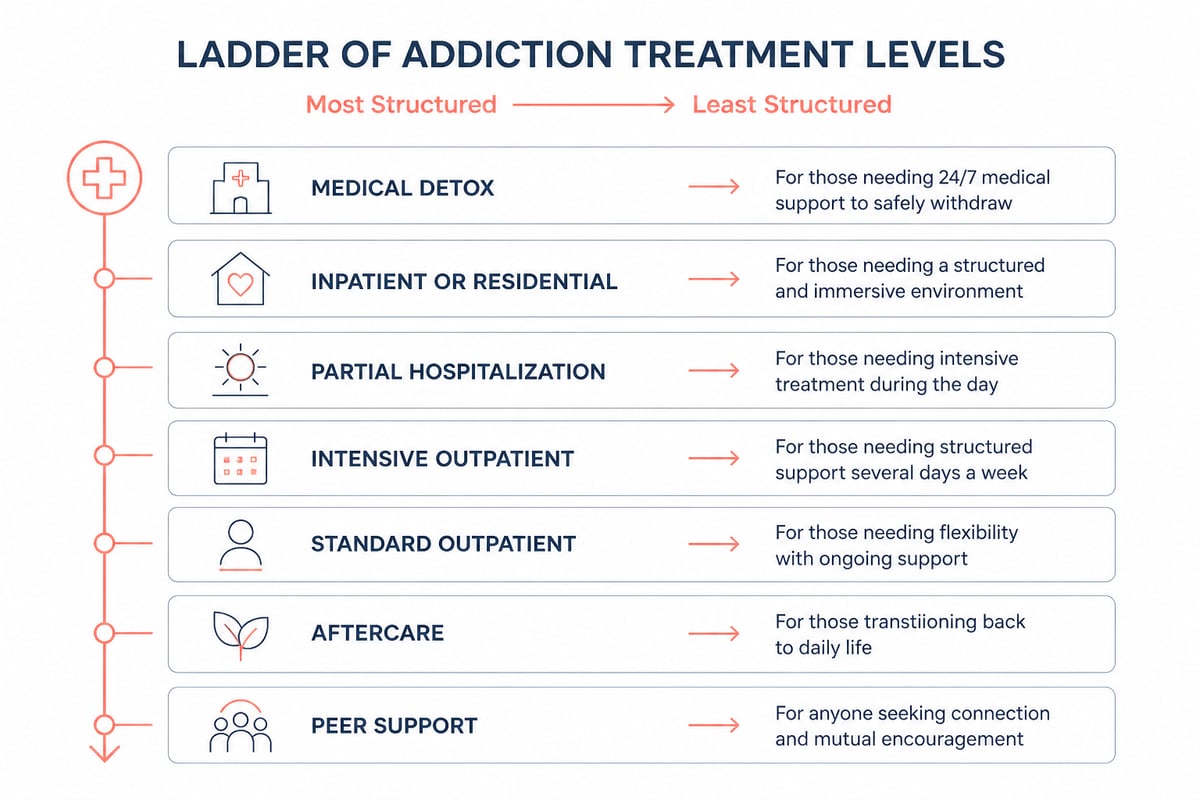
Medical detox
Detox manages withdrawal safely. It addresses the physical dependence but is not treatment by itself. Most clinicians recommend following detox with therapy, because stopping the substance without addressing the reasons for use leaves relapse risk high.
Inpatient or residential treatment
Inpatient rehab means living at the facility around the clock while receiving structured, supervised care. It suits people with severe or long-term addiction, unstable home environments, previous failed attempts at outpatient care, or medical and psychiatric needs that benefit from constant monitoring. The trade-off is time away from home and work.
Intensive outpatient and outpatient programs
Outpatient care allows you to live at home and attend therapy several days a week. It fits people with strong home support, a stable environment and a milder substance use disorder, or those stepping down from residential care.
How long does treatment last?
Duration varies widely. Maryland Addiction Recovery Center describes its overall program length and its Extended Care option as longer-term stays, and programs vary in length. Other facilities structure stays at 28 days or in 30-, 60- and 90-day blocks. A longer stay is not automatically better, but very short stays often need to be followed by a defined outpatient plan.
Maryland Drug Treatment Centers Compared
The programs below illustrate the range of what Maryland offers. Details come from published listings and reported information; confirm every specific directly with the facility, since services and pricing change.
-
Recovery Centers of America at Bracebridge Hall is a residential facility in Earleville set on a 560-acre property. It offers detox and residential treatment for substance use and co-occurring mental health disorders. It suits people who want a secluded residential setting with integrated mental health support.
-
Tranquility Woods Addiction Treatment Center is located in Pasadena and treats addiction alongside dual-diagnosis conditions. The facility is Joint Commission accredited, which is a meaningful quality signal. It suits people who need addiction care paired with attention to co-occurring mental health conditions.
-
Ashley Addiction Treatment in Havre de Grace offers residential treatment, medical detox and intensive outpatient care. It treats co-occurring disorders and provides Vivitrol-based therapy and equine-assisted therapy. Pricing is not listed in the sources, so confirm current costs directly with the facility. It suits adults and young adults who want residential care with several treatment options and supportive therapies.
-
The Freedom Center in Gaithersburg offers 30-, 60- and 90-day treatment options with cognitive behavioral therapy, dialectical behavior therapy, family therapy, dual-diagnosis care and relapse prevention. Outpatient services appear in a Maryland center comparison. It suits people who want clearly structured programs with evidence-based therapy and a choice of length.
-
Individual Care Center: Inpatient Substance Abuse Treatment provides residential addiction treatment with 24-hour medical supervision, individual and group therapy, medication management and aftercare planning. Each patient receives a tailored recovery plan, family members take an active part in the process, and care is holistic, combining counseling and medication with therapies such as acupuncture and yoga. Care is discreet and private. It suits people who want individualized inpatient care with family involvement.
-
Individual Care Center: Medication-Assisted Treatment (MAT) combines FDA-approved medication with counseling and behavioral therapy for opioid, alcohol and tobacco dependence. It suits people whose dependence responds well to medication alongside therapy, and it can be used within a broader treatment plan.
Contact each program for current pricing, admissions steps and availability, since those details are not fixed.
Questions to Ask Before You Choose a Drug Treatment Center in Maryland
The most reliable way to evaluate any program is to ask specific questions and expect specific answers.
- Is the facility licensed and accredited? Look for state licensure and accreditation such as the Joint Commission. Maryland Addiction Recovery Center, for example, lists accredited treatment services as part of how it presents itself.
- Who is on the clinical team? Ask about physicians, addiction-certified counselors and licensed therapists, and how many patients each clinician sees.
- Which therapies are evidence-based? Cognitive behavioral therapy, dialectical behavior therapy, motivational interviewing and medication-assisted treatment have research support. Therapies such as yoga or acupuncture are most useful as complements to those methods, not replacements.
- How are co-occurring conditions handled? Depression, anxiety and trauma often accompany addiction. A program that treats only the substance use may leave the underlying drivers unaddressed.
- What does aftercare look like? Ask what support follows discharge, and for how long.
- How is family involved? Family participation is associated with better engagement, and a good program has a defined way to include loved ones.
- What is the privacy policy? If confidentiality matters because of your job or community, ask how the facility protects it.

Paying for Treatment: Insurance, Costs and Verification
Cost depends on the level of care, length of stay and your insurance plan, so verify coverage before admission instead of assuming it. A 28-day residential stay, a multi-month extended care program and a few evenings of outpatient therapy each carry very different price tags, and insurers often treat them as separate benefits with separate rules.
Maryland Addiction Recovery Center says it is in-network with Curative and works with other major commercial insurers through out-of-network benefits, and that coverage and out-of-pocket costs depend on the individual plan. That pattern applies broadly: in-network status lowers your cost, while out-of-network benefits can still help but usually leave a larger share to you. Two people admitted to the same facility can therefore pay very different amounts depending on their deductible, copay structure and plan type.
Before you commit, work through this checklist:
- Request a benefits verification from the facility and from your insurer
- Ask whether the stay requires pre-authorization
- Confirm what is covered for detox, residential, outpatient and medication separately
- Ask about deductibles, copays and the maximum out-of-pocket amount
- Ask whether the facility offers payment plans or financial assistance
Get the answers in writing or note the date, the representative's name and a reference number for each call. Also ask what happens if your insurer approves only part of the stay, since some plans authorize a limited number of days and then require a clinical review to continue. Knowing the review schedule in advance lets you plan for a step-down to outpatient care instead of facing an unexpected bill.
The MARC admissions overview is one example of how a facility explains its intake process and how costs are determined. Whichever program you consider, expect a similar walkthrough from the admissions team.
Matching a Program to Your Situation
The best program is the one that fits your clinical needs, your home situation and your support system, and a few patterns help narrow the field.
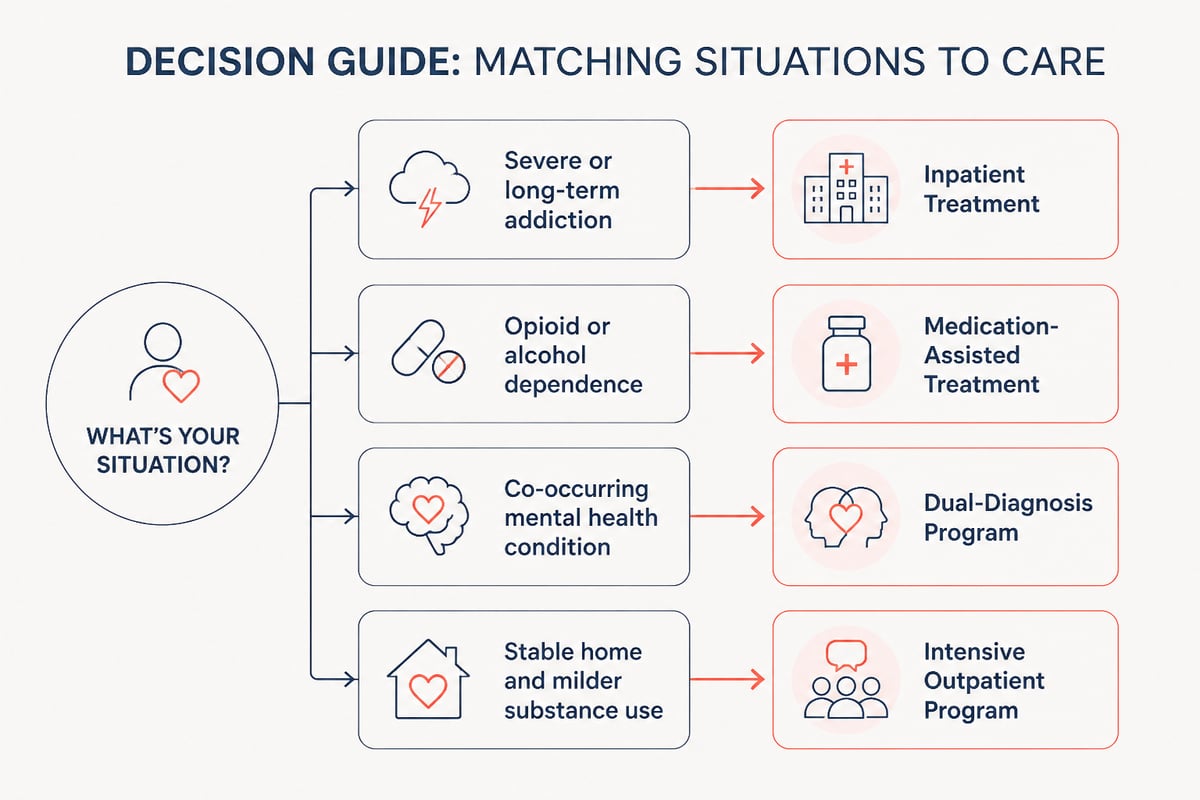
Severe or long-standing addiction. Residential treatment with medical supervision is usually the safer starting point, especially if withdrawal carries medical risk or past outpatient attempts have not held.
Opioid or alcohol dependence. Medication-assisted treatment can reduce cravings and support stability while therapy addresses behavior and triggers. Ask any program how medication is prescribed, monitored and adjusted.
Co-occurring mental health conditions. Choose a facility that treats both conditions together. Several Maryland programs, including Tranquility Woods, Ashley and The Freedom Center, describe dual-diagnosis care.
Need for privacy and continuity. Adults with careers and family responsibilities often prioritize discretion. Individual Care Center describes its care as discreet and private, so ask the facility how it protects confidentiality.
Family involvement. If your family wants to take part, favor programs with structured family therapy or family education. Individual Care Center involves family members actively in treatment, and The Freedom Center lists family therapy among its services.
Warning signs when evaluating a facility
- Guarantees of a cure or a specific success rate
- Pressure to decide the same day
- Vague answers about licensure, staffing or costs
- No plan for aftercare or co-occurring conditions
- Refusal to explain what insurance will and will not cover
Taking the First Step Toward Treatment
Starting is often the hardest part, and a short sequence of actions makes it manageable.
- Gather basic information. Note the substances used, how long and how often, any medical conditions, and current medications.
- Call your insurer. Ask about behavioral health benefits and which Maryland facilities are in-network.
- Speak with two or three programs. Use the questions above and compare answers on care level, therapies, family involvement and cost.
- Request a clinical assessment. A qualified clinician can recommend the right level of care instead of leaving you to guess.
- Plan for the transition. Arrange time off work, family communication and any responsibilities that need coverage.
Individual Care Center also publishes background on treatment programs, drug rehabilitation and drug addiction recovery that can help you and your family understand the options before making calls.
Treatment works best when it is chosen deliberately and started promptly, and a single conversation with an admissions specialist is often enough to clarify the next step.
If you or someone you love is ready to explore treatment, start by writing down the substances involved and your insurance details, then speak with an admissions specialist about the right level of care. Individual Care Center offers inpatient substance abuse treatment with 24-hour supervision and a recovery plan built around each patient, and you can reach the team directly through Individual Care Center, where you can call 866-693-1454 to talk through your situation and learn how inpatient rehab can support lasting recovery.